An aspiring author confronts the literary demons of the world and sets off in search of an agent.

Wednesday, December 8, 2010

The Much Awaited Sequel to Despereaux!

Desperadeaux: Being the tale of a Mouse, Billy the Kid,
Some Vigilantes, and a Pocketful Full of Gold Coins.

This eagerly awaited sequel to Despereaux features Desperadeaux, who is none other than the nephew of Despereaux. Unlike his uncle, Desperadeaux finds himself bored with the provincial ennui of Europe, the self-absorbed inanity endemic to those of royal blood and the seemingly never-ending arguments about how to make the perfect bowl of soup.  What’s more, he’s doesn’t understand why Despereaux thinks unrequited love is the best thing since sliced croissants.

Fortunately for Desperadeaux, the New World beckons!  Following a harrowing boat ride across the Atlantic (suffice to say, scurvy was the best thing that happened on that voyage!), he makes his way West to New Mexico where he meets none other than Billy the Kid. The famous outlaw is a man of many and massive faults, but he recognizes in the diminutive varmint a talented gunslinger. He tells Desperadeaux, “You might have the littlest gun in the West, but you got the quickest draw!”  In no time, the rodent’s hardscrabble demeanor and deadly aim endears him to Billy and his gang.

            “Reckon you and me are gonna do some serious wreckin’ round here,” says Billy as they saddle up for a foray into town.

            “Oui, pardner. Oui!” murmurs Desperadeaux with a rueful grin.
Share/Bookmark

Sunday, December 5, 2010

The Pleasure of Books

This spot on cartoon is from New Toons on the Blog. It's based on an insightful tweet by Hope Larson and features a cameo appearance by T.S. Eliot along with hundreds of selfless books who volunteered to serve as extras.


Share/Bookmark

Friday, December 3, 2010

The Unsuccessful Self-Treatment of a Case of “Writer's Block”

Apparently this was actually published in a refereed journal!


Share/Bookmark

Tuesday, November 30, 2010

Bildungsromanmania!

Today the Demon pays his respect (well, sort of!) to the bildungsroman, the coming of age novel. Wikipedia describes it as "a genre of the novel which focuses on the psychological and moral growth of the protagonist from youth to adulthood."

Here are several, heretofore undocumented, variations of the bildungsroman:

The Rückwärts-Richtung-Bildungsroman. This is the "reverse direction" Bildunsroman. Examples include The Curious Case of Benjamin Button or any novel featuring Merlin, who was reputed to age backwards through time.

The Ich-Will-Nicht-Erwachsen-Werden-Roman. This is the "I won’t grow up novel" and, of course, we're referring to Peter Pan.  Astute readers will likely complain this isn't a bildungsroman since the  protagonist doesn't demonstrate growth. This only proves that astute readers ought not waste their time perusing this blog!

The Déjà-vu-Bildungsroman. Think of the movie Groundhog Day where the protagonist, Bill Murray,  achieves growth only after living the same day over and over and over again.

The Roman-Gladiator-Bildungsroman.  These are stories of ancient Rome featuring young boys sent off to the ludus for gladiator training. This variation of the bildungsroman tends to be problematic as most protagonists do not live long enough to reach adulthood.

The Willy-Loman-Bildungsroman: This fall-from-grace variation was epitomized in Arthur Miller's Death of a Salesman.  Technically, it's not a bildungsroman, but who cares, the phrase just rolls off the tongue!


Share/Bookmark

Saturday, November 27, 2010

A Study in Contrasts: Aging, Atwood and Bradbury

How to describe an aging woman's body?  Here are two examples, starkly different, from two writers, each wonderful in their own way.

First, from Margaret Atwood's Cat's Eye:
  
I think of Cordelia examining the growing pouches under her eyes… Gnarling has set in, the withering of the mouth; the outlines of dewlaps are beginning to be visible, down towards the chin…She drops the bath towel…looks over her shoulder, sees in the mirror the dog's-neck folds of skin above the waist, the buttocks drooping like wattles…
  
Next, from Ray Bradbury's Dandelion Wine:

She sat down next to him on the swing in her nightgown, not slim the way girls get when they are not loved at seventeen, not fat the way women get when they are not loved at fifty, but absolutely right, a roundness, a firmness, the way women are at any age, he thought, when there is no question.

Hard to imagine a more stark contrast, eh? And that's the wonder of good writing, folks!

Share/Bookmark

Friday, November 26, 2010

A Grammar Girl Nightmare on Elm Street


The Demon is a fan of Grammar Girl and recommends her book, Grammar Girl's Quick and Dirty Tips for Better Writing.  To show his appreciation, the Demon offers this little homage:

Grammar Girl versus Freddy Krueger!

Share/Bookmark

Monday, November 22, 2010

Haiku as Query Letter

Recently, I read a fascinating comment about the query letter: "...because it is short, it's like the haiku of writing. It has to convey a vivid and memorable impression with as few words as possible."

What a wonderful image! And that sparked an idea. I looked over several haiku by Bashō, the famed Japanese poet of the Edo era, and tried to imagine which author might have used which haiku for one of their query letters. Here goes!

Nothing in the cry
of cicadas suggests they
are about to die


This feels like a Stephen King novel.


Wrapping dumplings in
bamboo leaves, with one finger
she tidies her hair


Margaret Atwood


A weathered skeleton
in windy fields of memory,
piercing like a knife


The Lovely Bones by Alice Seybold


I would like to use
that scarecrow's tattered clothes
in this midnight frost


Used by Neil Gaiman if he ever decided to re-imagine The Wizard of Oz.
Share/Bookmark

Saturday, November 20, 2010

Could I be a Genetic Enchanter?


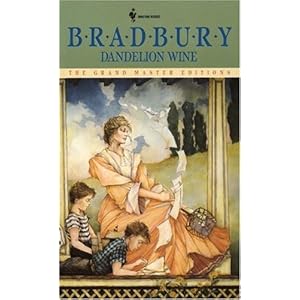
Last night, I began reading Dandelion Wine by Ray Bradbury. Ah, it does me good to reunite with a favorite author from my youth! However, I do notice that with age I am more likely to read an author’s introduction. When I was a teen, I did not have the patience for introductions – it was dive into the novel, full speed ahead with the plot, onwards with characters development.

Happily, I found the following gem, my reward for taking the time to read Mr. Bradbury’s introduction:

I was amused and somewhat astonished at a critic a few years back who wrote an article analyzing Dandelion Wine plus the more realistic works of Sinclair Lewis, wondering how I could have been born and raised in Waukegan, which I renamed Green Town for my novel, and not noticed how ugly the harbor was and how depressing the coal docks and railyards down below the town.

But, of course, I had noticed them and, genetic enchanter that I was, was fascinated by their beauty. Trains and boxcars and the smell of coal and fire are not ugly to children. Ugliness is a concept that we happen on later and become self-conscious about.

Genetic Enchanter…oh gawd, I love that phrase! Could it be possible that I am one? Could it mean that I, in some tickle-my-fancy manner, bear the slightest of kinship to the likes of a Ray Bradbury?

Sigh!

Share/Bookmark

Wednesday, November 17, 2010

Banana Moon

If you had to write a story to save your life, what would you write, where would your story begin?

Perhaps you’d find yourself beneath the desert sky one early evening, listening as young voices cry out, “banana moon!” There’s silver up above and children’s laughter floating in the air. With head bowed, you trace a broken heart in the sand.

The morning comes, the children dream of sand and silver and loving hearts, a plane ascends. Looking down you see, wandering amidst the mirage of bright lights and improbable fountains, those who have forgotten the magic of the desert. You close your eyes and listen for the sound of laughter; thirty minutes and one hundred and sixty miles later passes and you hear none.

Meanwhile, the man besides you, somber faced and grey-suited, is lost, but in a good way, as he reads Harry Potter and the Sorcerer’s Stone. A flight attendant brings you coffee and you ask for two sugars – the first for the coffee, the second you pour upon your tray so you may trace a broken heart. The plane purrs and rattles, the heart disappears.


Four days’ mail crams the mailbox and the unpacked suitcase is left to fend for itself. You walk to the bathroom, open the medicine cabinet and scowl; the door is open so the mirror reflects the wall, not your face. Soon, forty-two red and green pills float in the toilet bowl. You urinate but the deadly little armada refuses to sink. There’s nothing else to do but flush and walk away.

If you had to write a story to save your life, what would you write? Perhaps you’d write of a seemingly ordinary man in a grey suit who had an ordinary job, ordinary friends and uneventful days. But once a month, about the time the banana moon comes, he remembers the magic of the desert. One those days, while everyone else still sleeps, he rises early to usher in the dawn with soft laughter. 

Later, when all are sleeping, he smiles as he remembers the sound of children’s voices.

Yes, on those days when the banana moon comes, he is the first to laugh and the last to smile.

Share/Bookmark

Tuesday, November 16, 2010

Literary Jewels


From  Littlefy Jewelry: Littlefly jewelery is made by laminating hundreds sheets of paper together, then carefully finishing to a high gloss. The paper is selected and carefully removed from a book, and the jewelery re-inserted in the excavated space.

Share/Bookmark

Friday, November 12, 2010

An utterly ridiculous posting about LOTR

The recent news that director Peter Jackson will be taking the reins of upcoming Hobbit movie has gotten the Demon thinking about how books eventually end up as movies. Clearly, the LOTR movies benefited greatly from Computer-Generated Imagery (CGI). Ironic that a movie about such an ancient time could only be rendered by the most modern of technology, eh?

The first book in the LOTR trilogy was published in 1954. But what if (and here comes the ridiculous part of this post) Tolkien had published it much earlier, say in the late 1920s? One could imagine the first LOTR move being made back in the 1930s with stars such as Clark Gable and, who knows, even WC Fields! 

Here are two screen capture from this movie. (Note: The graphics may look amateurish; it's simply my attempt to painstakingly recreate what the special effects would have looked like for a movie from the 1930s)

Clark Gable as Aragorn as he speaks to
the troops before the Black Gates of Mordor

WC Fields plays Gollum!
A note to readers of this blog: it's okay to groan!


Share/Bookmark

Wednesday, November 10, 2010

Commas - in or out?

The Demon came across an interesting post by Daniel Adler entitled, Lamentation for the Comma, in which he states, "Oh, comma! Dear friend, connector of clauses, I am ridding my writing of you!" He correctly observes that commas are "sometimes burdensome."


Thus, it easy to imagine Lady Macbeth declaring, "Out, damn'd comma! out, I say!" Or maybe it should be “Out damn’d comma! out I say!” Okay, it's easy to imagine if you're me!


But as a counterpoint, let's invoke Oscar Wilde who said, “I was working on the proof of one of my poems all the morning, and took out a comma. In the afternoon I put it back again."


Commas! You can't live with 'em and you can't live without 'em!


'nuff said!
Share/Bookmark